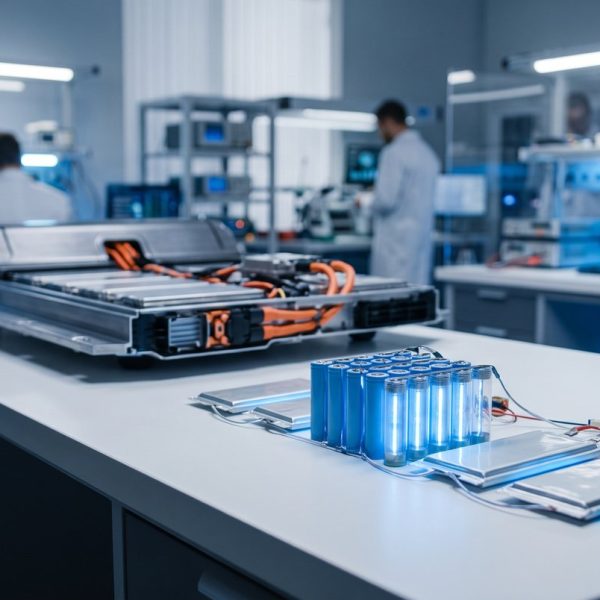
For more than a decade, the lithium-ion battery has quietly powered almost everything we own, from phones to cars to the backup systems that keep hospitals running. It has also reached the edge of what its chemistry can comfortably do. The next leap is already taking shape in labs and pilot factories around the world, and it has a deceptively dull name. The solid-state battery promises more range, faster charging, and far less risk of fire, and the companies that crack it first stand to reshape several industries at once.
What makes a solid-state battery different
The idea is simpler than it sounds. A conventional lithium-ion cell moves charge through a liquid or gel electrolyte, the wet medium that ions travel across between the two electrodes. That liquid is also the weak point. It is flammable, it degrades over time, and it limits how much energy you can safely pack into a given space. A solid-state battery replaces that liquid with a solid material, usually a ceramic or a specialized polymer. Swapping wet for solid sounds like a small change, but it unlocks a cascade of benefits and removes the single biggest safety hazard in modern cells.
Why everyone is racing to build one
The appeal comes down to three numbers that consumers actually care about. First, energy density. Solid electrolytes allow more energy in the same volume, which in a car translates to meaningfully longer range without a heavier pack. Second, charging speed. Many solid-state designs tolerate rapid charging far better, with the goal of a near-full charge in the time it takes to drink a coffee. Third, safety. With no flammable liquid inside, the risk of the thermal runaway that causes battery fires drops sharply. Add a longer lifespan, since solid cells tend to degrade more slowly, and you can see why this has become one of the most closely watched stories in technology.
The carmakers leading the charge
Automakers have the most to gain, and they are investing accordingly. Toyota has been among the most vocal, repeatedly signaling that its solid-state battery work could deliver dramatic range and charging improvements later this decade. It is far from alone. Established manufacturers and a cluster of well-funded startups are all chasing the same prize, and the steady drumbeat of solid-state battery news now includes pilot production lines rather than just lab results. The shift from press release to factory floor is the clearest sign yet that this technology is moving from promise to product. Strong local seo helps small businesses show up exactly when nearby customers are searching.
Beyond cars: the grid and your gadgets
Electric vehicles dominate the headlines, but the impact reaches much further. Cleaner, denser storage matters enormously for renewable energy storage, where the central challenge is holding solar and wind power for the hours when the sun sets and the air goes still. Safer, longer-lasting cells could make home and grid batteries more practical and less worrying to install. The same advantages apply to consumer electronics, where longer-running phones and laptops that survive more charge cycles would be a welcome change. As with most foundational technology, and as we have seen with the rise of artificial intelligence, the first uses people notice are rarely the most important ones in the long run.
Solid-state battery research moves between labs, patent offices and manufacturers in several countries, and almost none of that exchange happens in a single language. Precision in the underlying papers determines whether a result can actually be reproduced elsewhere. This guide to scientific translation is a useful look at the accuracy problems that slow that process down.
The hurdles that remain
None of this is guaranteed, and honesty matters here. Making solid-state cells reliably and cheaply at the scale of millions of units is genuinely hard. Solid electrolytes can crack, the contact between solid layers can degrade, and the manufacturing methods that work in a lab do not always survive contact with a real production line. Cost is the stubborn obstacle. Early solid-state batteries are expensive to build, and they will need to come down a long way before they reach ordinary buyers. Several promised launch dates have already slipped, which is a useful reminder to treat bold timelines with healthy caution.
What it could mean for everyday drivers
Strip away the chemistry and the corporate announcements, and the practical promise is easy to picture. Imagine an electric car that travels significantly farther on a charge, refills most of the way during a short stop, holds its range well after years of use, and carries far less fire risk in a crash. Those four improvements together would erase most of the lingering reasons people hesitate before going electric. Range anxiety, slow charging, and worries about battery wear are the objections that come up again and again, and a mature solid-state battery answers all three at once. That is why the technology matters beyond the spec sheets. It targets the exact friction points that have kept many drivers on the fence, and doing so could accelerate the shift to electric transport in a way that incremental tweaks to current batteries never quite manage.
When you will actually see them
The realistic picture is gradual rather than sudden. Expect solid-state batteries to appear first in premium vehicles and specialized devices, where buyers will pay for the advantages, before slowly working their way into everyday products as costs fall. For a deeper technical grounding, the overview on Wikipedia lays out the chemistry clearly, and enthusiasts track every announcement and setback in communities like the r/batteries subreddit. The revolution will not arrive overnight, but it is closer than most people realize, and the groundwork being laid now will quietly define the next decade of how we store and use energy.